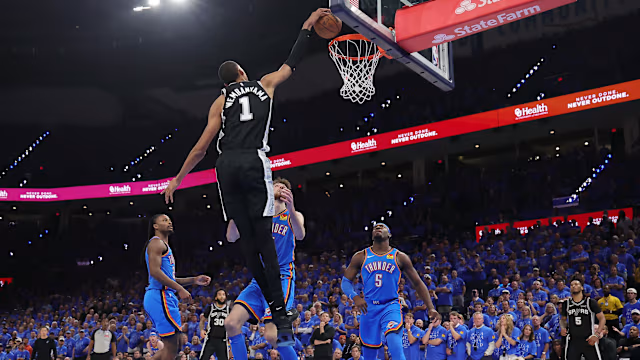
Olympic basketball and the NBA are not rival versions of the same event. One is a short national-team tournament held every four years; the other is the world’s strongest long-form professional league. Prestige depends on whether a reader values sustained excellence, national representation, or performance under a compressed tournament format.
The formats create different tests
| Dimension | Olympic tournament | NBA season |
|---|---|---|
| Team identity | National team | Professional club |
| Frequency | Every four years | Annual season |
| Preparation | Short camps and limited games | Training camp, 82-game regular season, playoffs |
| Roster building | Nationality and federation eligibility | Draft, trades, contracts, free agency |
| Failure margin | Very small in knockout play | Series allow adjustment over multiple games |
Rules change strategy
Olympic competition uses FIBA rules, while the NBA uses its own rulebook. Court dimensions, game length, three-point distance, defensive restrictions, timeout procedures, foul rules, and treatment of the ball above the cylinder are not identical. These differences influence spacing, rim protection, pace, and late-game decisions.
International teams may use more compact defensive structures because FIBA does not apply the NBA defensive three-second rule. A shorter game also makes a poor quarter more costly. NBA teams, by contrast, have more possessions and more game-to-game information during a playoff series.
Why Olympic medals carry unusual emotional weight
An Olympic roster represents a country, and many players receive only one or two realistic chances during their peak years. The event also brings different basketball traditions into one tournament. Winning gold can therefore hold cultural significance beyond a normal professional championship.
Why the NBA title remains the deeper competitive sample
An NBA champion must survive a full regular season and four playoff rounds. Teams face repeated scouting, travel, injuries, lineup changes, and best-of-seven adjustments. That larger sample rewards durability, roster depth, coaching adaptation, and repeatable performance.
Is one achievement harder?
The answer changes with context. A favored national team may have unmatched talent but little preparation time. A less-favored team may need one extraordinary knockout performance. In the NBA, a weak game can be recovered from, but winning four long series against elite opponents is exceptionally demanding.
A better way to compare prestige
- Individual career evaluation: NBA performance offers the larger sample.
- National sporting history: an Olympic medal may matter more.
- Tactical adaptability: both test it, on different timelines.
- Rarity: Olympic opportunities are scarcer; NBA championships occur annually.
Sources
Competition rules and formats can change. Consult the governing body for the current edition.
