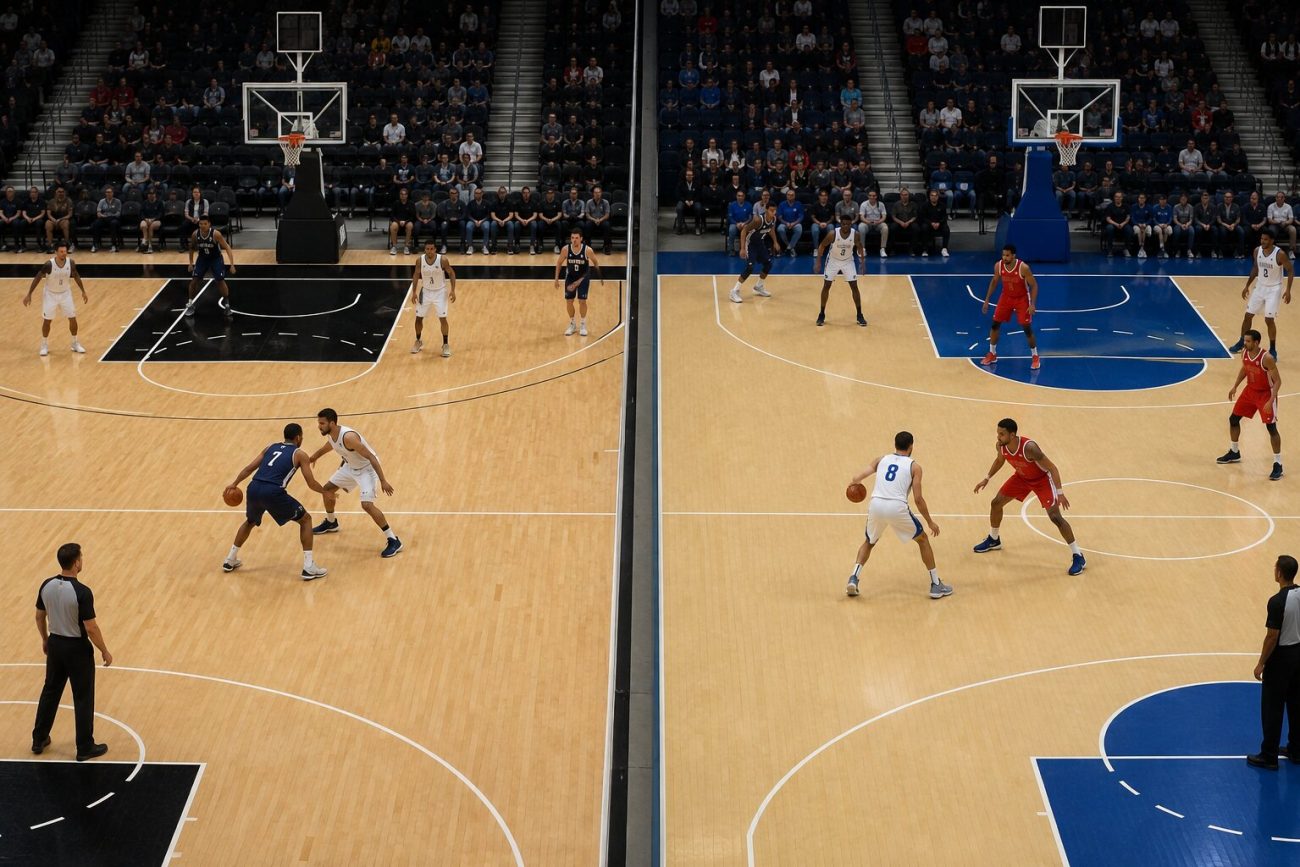
NBA and FIBA basketball share the same basic objective but use different rulebooks. Those differences affect spacing, defensive strategy, late-game management, and how players transition between competitions.
Key differences to verify
| Area | NBA | FIBA |
|---|---|---|
| Game length | Four 12-minute quarters | Four 10-minute quarters |
| Court and three-point line | Larger court and longer arc | Slightly smaller dimensions |
| Defensive three seconds | Applies | No equivalent NBA-style restriction |
| Ball above cylinder | Restricted within imaginary cylinder | Playable after contacting rim under FIBA rules |
| Timeout administration | NBA-specific allocation and procedures | Coach-requested under FIBA procedures |
Strategic consequences
Without the NBA defensive three-second rule, FIBA defenses can maintain a compact rim-protection presence. The shorter game reduces the number of possessions available to recover from a poor stretch. Differences in timeout and foul procedures also change late-game decisions.
Do not rely on memory
Both organizations update rules and interpretations. Youth, school, and domestic leagues may use modified versions, so players and coaches should read the current competition rules rather than assume “international rules” apply everywhere.
Sources
Rules and interpretations can change; current official documents control.
