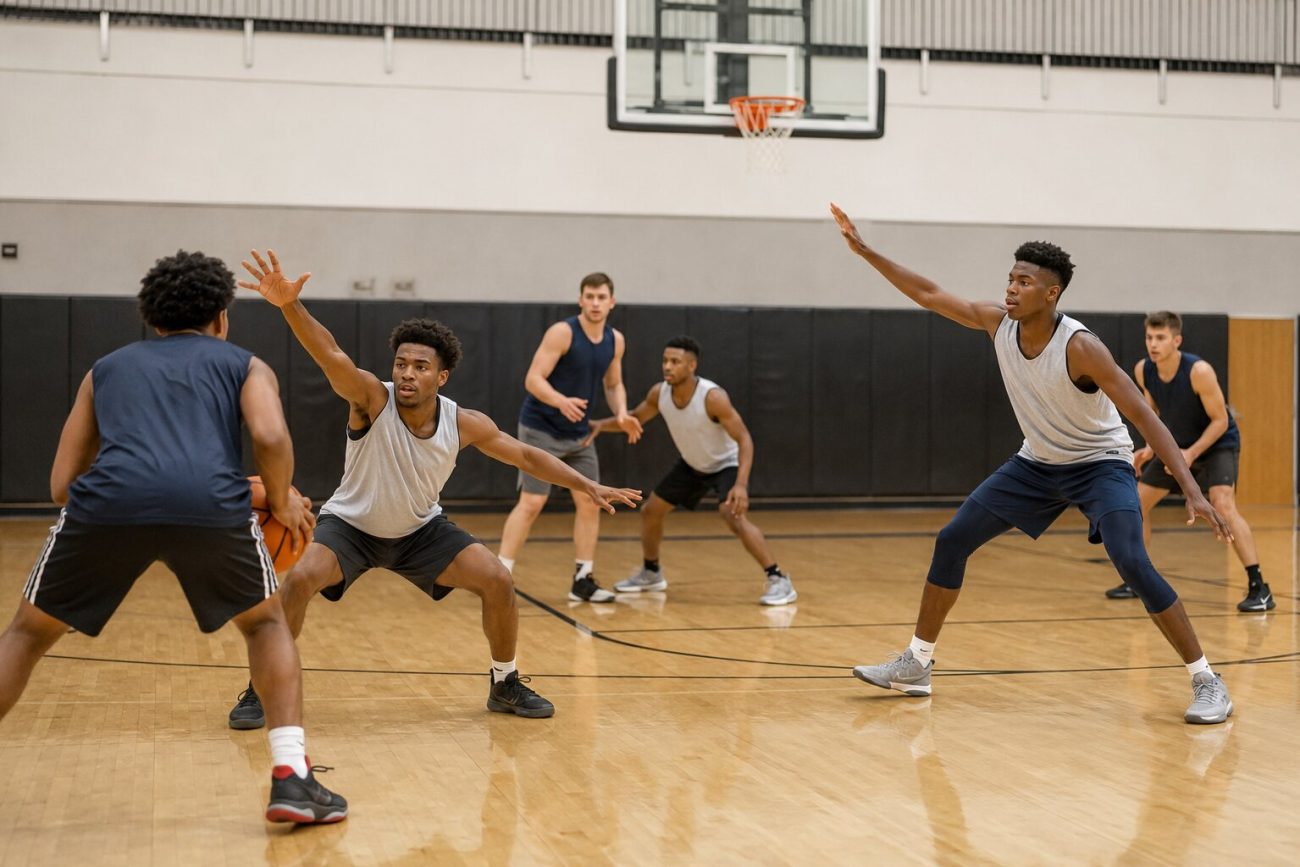
Defense is not a choice between “man” and “zone.” Every system needs ball pressure, help positioning, communication, rebounding, and a plan for screens. Coverage labels describe responsibilities; execution determines whether they work.
Core coverage families
| Coverage | Main purpose | Common vulnerability |
|---|---|---|
| Man-to-man | Assign direct matchups | Back cuts and screening confusion |
| Zone | Protect areas and load the paint | Gaps, offensive rebounds, and overloads |
| Switch | Keep a defender attached through screens | Mismatches and weak rebounding |
| Drop | Keep the big near the rim | Pull-ups and pocket passes |
| Blitz | Pressure the ball handler with two defenders | Short-roll numbers disadvantage |
Help and recover
A defender should help far enough to stop the immediate threat while remaining able to recover or rotate. Watching the ball alone loses cutters; watching only a player misses drives. Position should allow both to be seen.
Closeouts
A closeout turns a rotation into an individual possession. Sprint most of the distance, shorten steps near the shooter, stay balanced, and guide the attack toward team help. Flying past the shooter simply creates a new advantage.
Every possession ends with a rebound
Forcing a miss is incomplete if the offense recovers the ball. Zone defenders must identify bodies rather than assume an area will rebound itself.
Practice progression
- Teach stance, gap, and ball-you-player positioning.
- Use two-on-two closeout and help drills.
- Add a screen and one named coverage.
- Progress to four-on-four shell play.
- Score the defense only after a rebound or turnover.
Sources
Contact and drill intensity should be appropriate to player age and experience.
